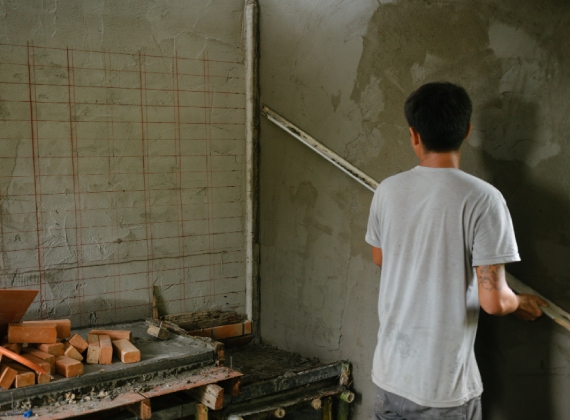
Crooked walls and cracked plaster are the biggest complaints after building. Indian Mestri connects you with trained masonry contractors and wall plastering services who build straight brickwork and smooth plaster that supports premium paint and tile finishes.
Dedicated masonry contractors, not random helpers – We connect you to specialist masonry contractors whose core work is brick masonry and plastering, not all-purpose labour that “does a bit of everything” on site.
Correct mix ratios and curing schedules – Wall plastering services follow specified cement-sand ratios and curing days, dramatically reducing hollow sounds, surface waves and shrinkage cracks.
Alignment checked with modern tools – String lines, spirit levels and aluminium straightedges are used across rooms so door frames, window frames and cabinets line up perfectly without packing or forcing.
Compatibility with your structural design – Masons follow wall thicknesses, bonding patterns and openings exactly as shown on structural drawings, protecting the load path instead of improvising on site.
Less rework for tiling and painting teams – Flat, plumb walls and accurate corners make tile and paint application far easier, saving time and material for downstream trades and improving the final look.
Targeted repair of problem walls – For renovation projects, masonry contractors identify which walls genuinely need rebuilding versus which can be repaired, optimising your budget without compromising safety.
Transparent per-square-foot rates – You receive clear area calculations and rates for brickwork and plastering, so you understand exactly how much each surface costs before work starts.
Why masonry quality affects your whole project
Many homeowners focus on tiles and paint but ignore who is doing the brick masonry and plastering. Poorly built walls lead to misaligned doors, uneven skirting and cracked corners that even the best painter cannot fully hide. Weak joints can transfer moisture and sound between rooms. With Indian Mestri, your masonry and plastering work is handled by contractors whose main skill is wall construction. They understand structural drawings, bonding details and mortar quality. As a result, every later trade—tiling, carpentry, painting—finds it easier to deliver a high-end finish. Investing in good masonry contractors is one of the lowest-cost, highest-impact decisions you can make for your home.
Our approach to crack-free plaster
Crack-free plaster is a process, not a miracle product. Our plastering teams start by preparing the surface properly, removing loose material and dampening the background. They use the right cement-sand ratios for internal and external work, and add waterproofing or plasticisers where needed. Thickness is controlled with screeds and straightedges so the surface stays uniform. At junctions of RCC and brick or different materials, mesh is applied to reduce stress. Finally, curing is done systematically for the recommended number of days. This combination of correct preparation, mix, thickness and curing drastically reduces common issues like hollow sounds, random cracks and dusting plaster.
Materials and mixes we generally recommend
Material selection depends on your structural engineer’s design, climate and budget. Our masonry contractors commonly work with clay bricks, fly-ash bricks, AAC blocks and concrete blocks. Each has its own compressive strength, weight and thermal behaviour, so we follow what is specified in the drawings. For plaster, typical mixes range from 1:4 to 1:6 cement-sand, adjusted for location and exposure. In bathrooms, balconies and terraces, waterproofing compounds are added as per manufacturer instructions. Where very smooth surfaces are required, POP or gypsum punning is used as a thin finishing layer over cement plaster. Whatever the combination, the priority is to use graded sand, clean water and fresh cement, not the cheapest materials available.
Measuring and pricing masonry & plastering work
A common confusion for homeowners is how masonry and plastering quantities are measured. Our contractors follow standard measurement rules, deducting openings above a specified size and clearly mentioning inclusions such as jambs or soffits. Rates are usually quoted per square foot or per square metre, with different rates for thick structural walls, partition walls and high or hard-to-reach areas. During estimation, quantities based on drawings are shared with you along with the unit rates, so you can verify calculations. For renovation works where exact areas are hard to predict, lump-sum or day-work models may be suggested, but even then we try to give a realistic range upfront so budgeting becomes easier.
Need straight walls and smooth plaster?
Share your drawings or photos of existing issues, and we’ll connect you with trained masonry contractors and wall plastering services who can build or repair walls correctly the first time.
Why is skilled masonry and plastering so important for my project?
Walls and plaster are what you see and touch every day, so their quality strongly influences how “finished” your home feels. Poor masonry can lead to misaligned corners, varying wall thickness and weak joints, all of which make it harder to install doors, windows and furniture correctly. Similarly, rushed plastering with wrong mix ratios or inadequate curing often results in hollows, undulations and cracks that show up clearly once the paint goes on. Fixing these defects later is messy and expensive because it usually involves chipping, re‑plastering and repainting large areas. By hiring trained masons and plaster specialists through Indian Mestri, you ensure that these foundational activities are executed correctly the first time. Our teams work with levels, straight edges and proper gauges, and they are evaluated on the uniformity of their work. This disciplined approach not only improves aesthetics but also supports structural integrity and reduces long‑term maintenance.
Can I hire Indian Mestri only for masonry or plastering, without full construction?
Yes, many homeowners approach us specifically for masonry and plastering support. Sometimes the main structure has already been completed by another contractor, but you want a more skilled team to handle the walls and finishes. In other cases, renovation projects require selective demolition and rebuilding of certain walls or the repair of cracked, hollow or damp plaster. Our platform allows you to request only the scope you need. After understanding your drawings and site condition, we connect you with teams comfortable working under different supervision models – such as executing under your existing civil contractor, architect or engineer. Clear division of responsibilities and measurements is agreed upfront to avoid overlap or confusion. This flexibility lets you upgrade the most sensitive parts of your project with professional workmanship, even if you do not wish to change the entire contractor setup.
How do your teams control cracks and hollows in plaster?
Controlling cracks and hollows starts long before the final trowel stroke. Our plastering specialists begin by assessing the base surface – whether it is fresh masonry, old plaster, concrete or a combination. Loose material is removed and the background is dampened appropriately so it does not absorb water too quickly from the new mix. For areas where different materials meet, such as at RCC and brick junctions, fibre or wire mesh may be used to reduce stress concentration. The plaster mix itself is prepared with the right cement‑sand proportion for the application, and in wet zones, suitable additives can be introduced. During application, thickness is controlled using screeds and guides instead of guesswork, ensuring that the surface remains even. Finally, systematic curing over the recommended number of days allows the plaster to gain strength gradually and reduces shrinkage cracks. This holistic, methodical approach is what distinguishes trained professionals from casual labour.
What materials do you generally use for masonry and plastering?
Material choices depend on the structural design, local availability and the performance you expect from your walls. For masonry, our teams commonly work with clay bricks, fly‑ash bricks, concrete blocks and AAC blocks. Each material has its own advantages in terms of strength, thermal comfort and cost. For plastering, we typically use cement‑sand mixes in different ratios for internal and external surfaces, sometimes combined with plasticisers or waterproofing compounds, particularly in bathrooms, balconies and external facades. POP or gypsum‑based materials may be used as thin finishing layers where very smooth surfaces are required for specific paint systems. Regardless of the exact combination, our focus is on following manufacturer recommendations and good site practices rather than cutting corners on quality. If you have already chosen a particular brand or system with your architect or engineer, our masons can align with those specifications.
How are masonry and plastering charges usually calculated?
Charges for masonry and plastering are generally based on measured area, expressed as per‑square‑foot or per‑square‑metre rates. The rate itself depends on wall thickness, height, complexity, scaffold requirements and the type of material being used. For example, working at higher floors, on curved walls or in tight shafts may cost more than straightforward ground‑floor work. During the estimate stage, our partnered contractors take site measurements and consult the drawings before proposing quantities and rates. We encourage transparent documentation where the basis of measurement is clearly mentioned, including deductions for openings like doors and windows. In some renovation cases, day‑wise or lump‑sum pricing may be more practical due to the unpredictable nature of the work. Whatever the model, the goal is to give you clarity before starting, so you can budget appropriately and compare options on a fair basis.