
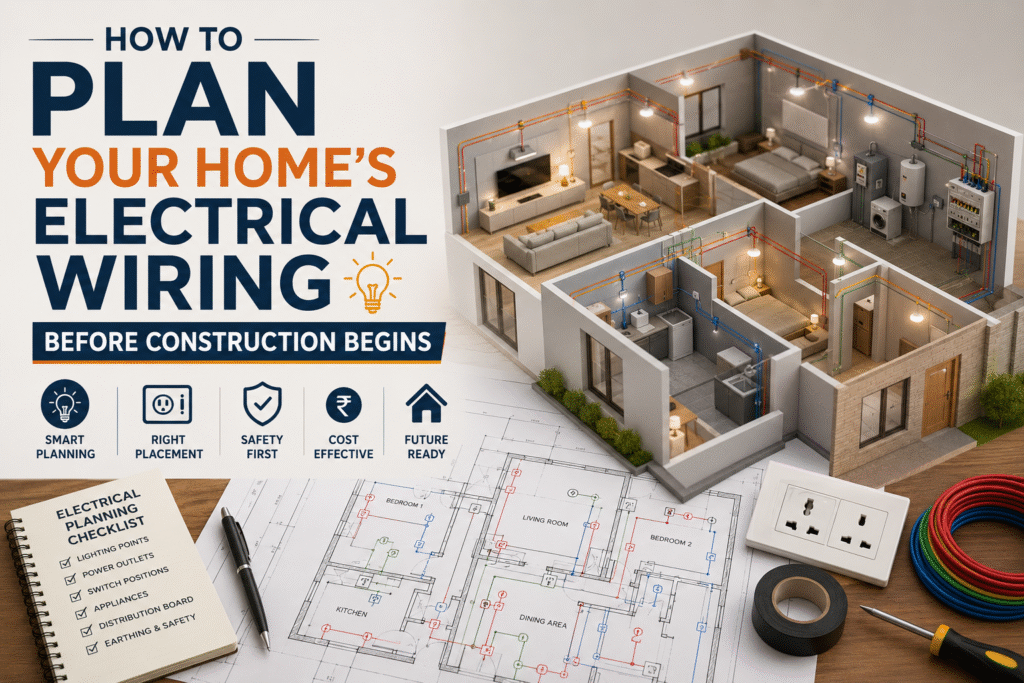
Getting your home’s electrical wiring right before the first brick is laid can save you tens of thousands in retrofits — and protect your family for decades. Here’s a room-by-room, step-by-step planning guide every homeowner should read before breaking ground.
Electrical planning is one of the most overlooked steps in new home construction. Most homeowners focus on floor plans, facades, and finishes — and leave electrical decisions to the last minute. The problem? Once walls are closed, changing a circuit or adding an outlet can cost 10–15× more than planning it upfront.
Whether you’re building from scratch or doing a major renovation, this guide walks you through everything you need to plan before your electrician ever shows up on site.
1Start with an Electrical Load Estimate
Before you sketch a single wire, calculate how much power your home will actually consume. This is called a load calculation, and it determines the size of your main service panel — the central hub all electricity flows through.
A standard modern home typically requires a 200-amp panel. If you plan to add an EV charger, a home office, a workshop, or multiple HVAC units, upgrade to 400 amps from the start. Panels are cheap to upsize during construction; they’re extremely expensive to upgrade later.
Pro Tip
Your electrician will perform an official load calculation per the National Electrical Code (NEC) Article 220, but you should have a rough figure ready before hiring. Online load calculators can give you a ballpark in under 10 minutes.
2Map Every Room’s Electrical Needs
Walk through your architectural floor plan room by room and mark where you’ll need outlets, switches, and fixed appliances. Be specific — think about furniture placement, desk positions, kitchen appliance locations, and TV wall mounts.
Kitchen
Dedicated 20A circuits for each major appliance. GFCI outlets on every counter within 4 ft of the sink.
Bedrooms
Minimum 2 circuits. USB outlets near the bed. Pre-wire for ceiling fans and future ACs.
Bathrooms
Dedicated 20A GFCI circuit. Exhaust fan with separate switch. Heated floor circuit if planned.
Living Room
Outlets every 6 ft on walls. Pre-wire for in-wall surround sound and projector/TV mount.
Garage
50A 240V circuit for EV charger. 20A circuits for tools. Outdoor GFCI outlets.
Home Office
Dedicated 20A circuit. Multiple data/ethernet ports. UPS-ready surge protection.
3Plan Dedicated Circuits for High-Draw Appliances
Shared circuits trip breakers and reduce appliance lifespan. Any appliance drawing more than 1,000 watts continuously should have its own dedicated circuit. This includes your HVAC unit, water heater, electric range, oven, dishwasher, refrigerator, washing machine, dryer, and EV charger.
Planning dedicated circuits now prevents nuisance tripping, reduces fire risk, and keeps your panel organized. Label each breaker in your panel clearly — it’s a small step that saves enormous trouble later.
Dedicated Circuit Planning Checklist
- Main HVAC / air conditioner (240V)
- Electric water heater (240V, 30A)
- Kitchen refrigerator (20A)
- Electric range or cooktop (50A, 240V)
- Dishwasher (20A)
- Clothes washer (20A)
- Clothes dryer (240V, 30A)
- EV charger rough-in (50A, 240V)
- Home office / server room (20A)
- Outdoor outlets and landscape lighting
4Decide on Smart Home and Low-Voltage Pre-Wiring
New construction is the perfect — and arguably the only affordable — time to pre-wire for smart home systems. Running conduit and Cat6 ethernet cables through walls costs a fraction of what it would after drywall is installed.
Even if you don’t plan to install smart systems immediately, rough-in the infrastructure now. This includes ethernet in every room (for fast, reliable connectivity over Wi-Fi), speaker wire runs for built-in audio, conduit for security cameras, and HDMI pathways behind TV mounting walls.
Future-Proofing
Pull an empty conduit from your main panel to the attic or crawl space. This “home run” gives you a dedicated pathway to add circuits anywhere in the house in the future — without opening walls. A 10-minute task during construction that eliminates hours of work later.
5Code Compliance: Know Your Local Requirements
Electrical codes vary by country, state, and municipality. In India, the Bureau of Indian Standards (BIS) code (IS 732) governs electrical installations. In the US, the National Electrical Code (NEC) sets the baseline, with local jurisdictions often adding stricter rules.
Key requirements to confirm with your local authority include: GFCI protection in wet areas, AFCI (arc-fault circuit interrupter) protection in living areas, tamper-resistant outlets in homes with children, outdoor weatherproof outlet covers, and smoke/carbon monoxide detector placement and wiring.
Your electrician must pull permits and schedule inspections at rough-in and final stages. Never skip this — uninspected electrical work can void your home insurance and create liability in a sale.
6Prepare a Clear Electrical Drawing for Your Contractor
A formal electrical drawing — even a hand-sketched one — dramatically reduces miscommunication on site. Mark outlet locations, switch positions, panel location, circuit groupings, and any special requirements (like dimmable circuits or 3-way switches) on a copy of your floor plan.
Share this drawing with at least three licensed electricians when getting quotes. Wildly different quotes often signal that contractors are assuming different scopes of work. A clear drawing aligns everyone from day one.
✓Final Takeaway
Electrical planning before construction is one of the highest-ROI investments you can make as a homeowner. Spend two to three hours mapping your load requirements, room-by-room needs, dedicated circuits, and smart home pre-wiring — and you’ll avoid costly retrofits, tripped breakers, and underserved rooms for the entire life of your home. Always hire a licensed electrician and get all work inspected.
Frequently Asked Questions
How many electrical outlets do I need per room?
The NEC requires no wall point to be more than 6 feet from an outlet, meaning outlets every 12 feet of wall length as a minimum. In practice, for modern living you should aim for outlets every 6 feet in living areas, and every 4 feet on kitchen countertops. Bedrooms benefit from 4–6 outlets, and home offices should have 8 or more, plus dedicated data ports.
What size electrical panel do I need for a new home?
A 200-amp panel is the modern standard for an average 3–4 bedroom home. However, if you plan to install an EV charger, solar panels, a pool, a workshop, or multiple HVAC units, you should seriously consider a 400-amp panel from the start. Upsizing a panel after construction can cost ₹1–3 lakh (or $3,000–$8,000 in the US), versus a fraction of that during the build.
What is the difference between GFCI and AFCI protection?
GFCI (Ground Fault Circuit Interrupter) protects people from electric shock caused by ground faults — primarily in wet areas like kitchens, bathrooms, and outdoors. AFCI (Arc Fault Circuit Interrupter) protects against electrical fires caused by arcing faults in wiring — primarily in living areas, bedrooms, and corridors. Modern electrical codes require both in new construction, and both should be planned for during the wiring phase.
Should I pre-wire for solar panels and EV chargers even if I don’t plan to use them now?
Yes, absolutely. Running conduit and reserving panel space for a future solar connection and EV charger costs very little during construction — typically under ₹10,000–₹20,000. Adding it later involves opening walls, upgrading the panel, and potentially trenching if the garage is separate. With EV adoption accelerating, planning for this now is one of the smartest future-proofing decisions you can make.
Do I need a separate electrical plan from an architect before hiring an electrician?
For large homes or complex builds, a formal electrical plan drawn by a licensed electrical engineer or architect is strongly recommended and may be required by your local municipality for permit approval. For smaller builds, a detailed annotated floor plan showing outlet positions, circuit groupings, panel location, and special loads is often sufficient for permitting and contractor quoting. Always check your local building authority’s requirements before starting.
How much does home electrical wiring cost for new construction?
Costs vary significantly by region, home size, and scope. In India, new home electrical wiring typically costs ₹80–₹200 per square foot depending on the grade of materials and complexity. In the US, expect $3–$8 per square foot. A 2,000 sq ft home might run $8,000–$20,000 for complete electrical work. Investing in higher-quality wiring, a larger panel, and smart home pre-wiring upfront consistently delivers a strong return in reduced future costs and home resale value.